
RIZAL HISTORIC TRAIL
A unique hiking trail between Wilhelmsfeld and Heidelberg, bringing history, culture and the special bond between Germany and the Philippines to life.
Diese Inhalte sind auch auf Deutsch 🇩🇪 verfügbar.
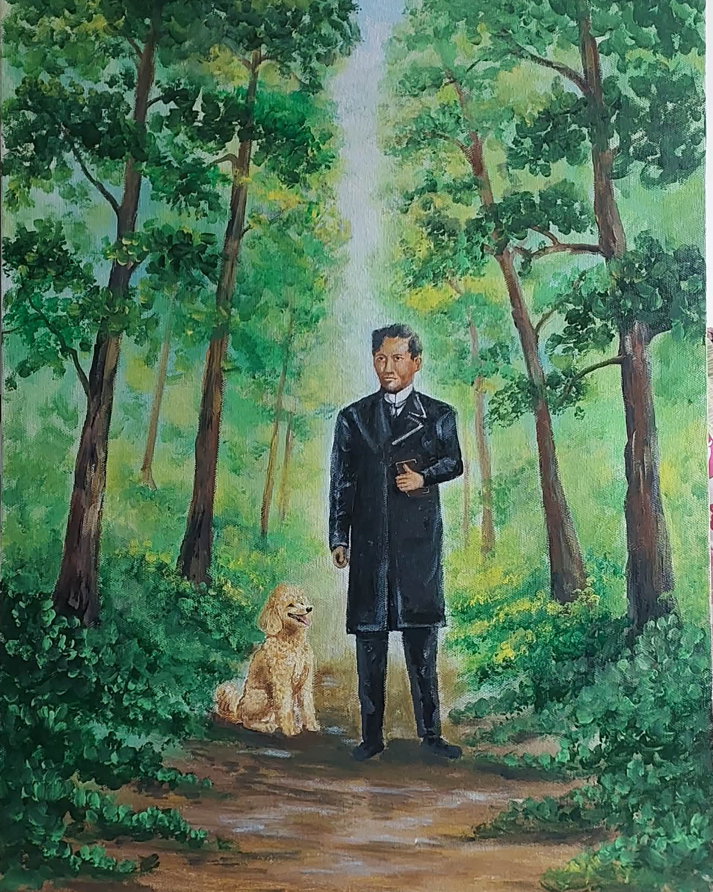
The Rizal Historic Trail
In 2025, Germany and the Philippines celebrated 70 years of diplomatic relations between the two countries. The Philippines were also the Guest of Honor at the Frankfurt Book Fair. The national hero of the Philippines, Dr. José Rizal, was consistently mentioned in writings and events, as he was, and still is, an important link between the two countries. Dr. José Rizal studied in Heidelberg for several months in 1886 and lived in Wilhelmsfeld for some time with the local Pastor, Karl Ullmer. He travelled on foot between the two places.
To commemorate this, the Wilhelmsfeld-Heidelberg Chapter of the Knights of Rizal, in cooperation with the municipality of Wilhelmsfeld, established the Rizal Historic Trail as a unique project that brings to life the history and cultural connection with the Philippines in our region. This hiking trail allows visitors to retrace the daily journey to work made by Dr. José Rizal from Wilhelmsfeld to Heidelberg and, in doing so, experience a part of regional history at first hand. At the same time, the hiking trail connects the memorial sites dedicated to Dr. Rizal in Heidelberg and Wilhelmsfeld, thus creating a historical link.
The hiking trail follows the original paths and locations that make it possible to retrace Dr. José Rizal’s daily route to the Heidelberg University Eye Clinic in 1886 and illustrate what the daily journey to work was like at that time.
The aim is to make history tangible and to promote awareness of regional history.
A collective effort for our region
This project is the result of the dedication and commitment of many individuals. It was created out of a deep appreciation for our region and a desire to preserve the enduring legacy of Dr. José Rizal. Through the generous support of our partners, sponsors, and volunteers—and countless hours of voluntary work—this vision has become a reality.
Lead responsibility for concept, planning, and implementation:
Sir Herbert Ehses, KCR – Chapter Commander of the Chapter Wilhelmsfeld-Heidelberg of the Knights of Rizal.
We gratefully acknowledge the support of all supporters, volunteers and contributors:
Dr. Fritz Hack-Ullmer, the Consulate General of the Philippines, Sir Dominik Schäfer-KR, Sir Michael Wolf-KCR, Sir Klaus Höhr-KR, Klaus Rehberger, the Municipality of Wilhelmsfeld including its Municipal Administration and Public Works Department, as well as Jeanette Reckmann.
We kindly request that the intellectual property and usage rights relating to the contents of this project be respected.
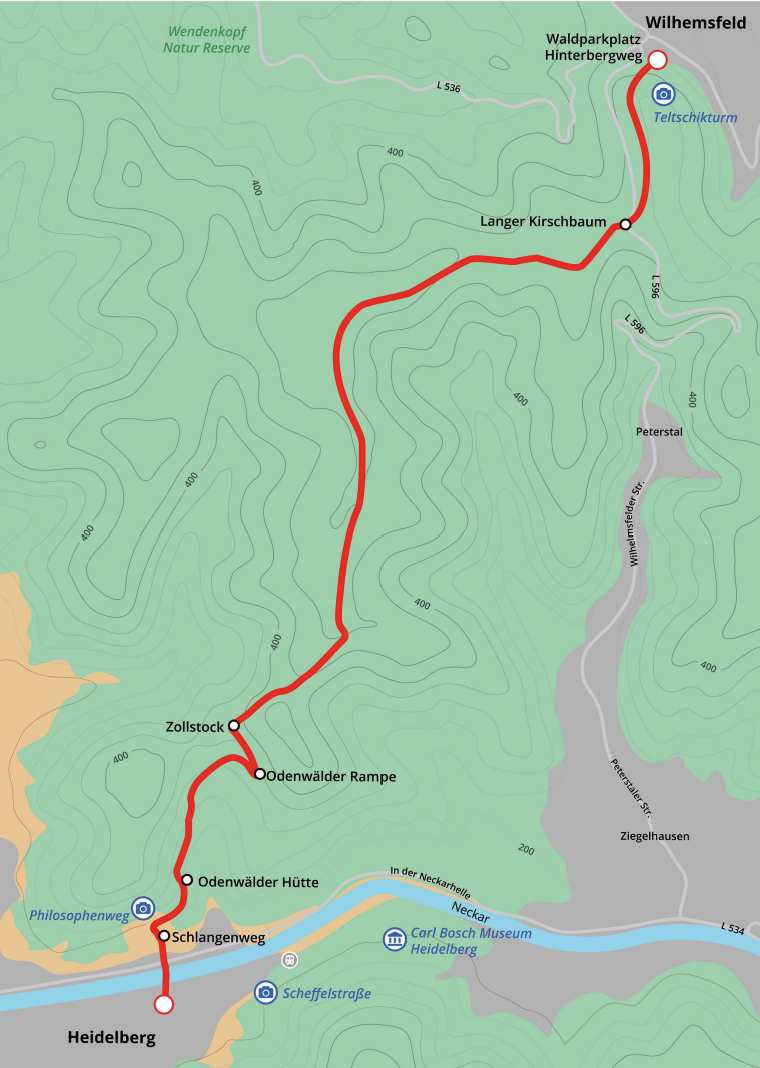
Starting Points of the Rizal Historic Trail
Starting point 1
WILHELMSFELD / HIKING CAR PARK HINTERBERGWEG
You can park in Wilhelmsfeld, provided you have not arrived by public transport, and either begin the trail at Rizal Park or at the Wilhelmsfeld Parish House before walking to the hiking car park. Alternatively, you may drive directly to the hiking car park and park there.
Here you will also find an information board with the most important information about the Rizal Historic Trail.
Starting point 2
HIKING CAR PARK LANGER KIRSCHBAUM
The car park can either be reached directly by car or by public transport on bus route 34 from both Wilhelmsfeld and Heidelberg (stop “Langer Kirschbaum”).
At the shelter in the car park you will find the information board for the Rizal Historic Trail.
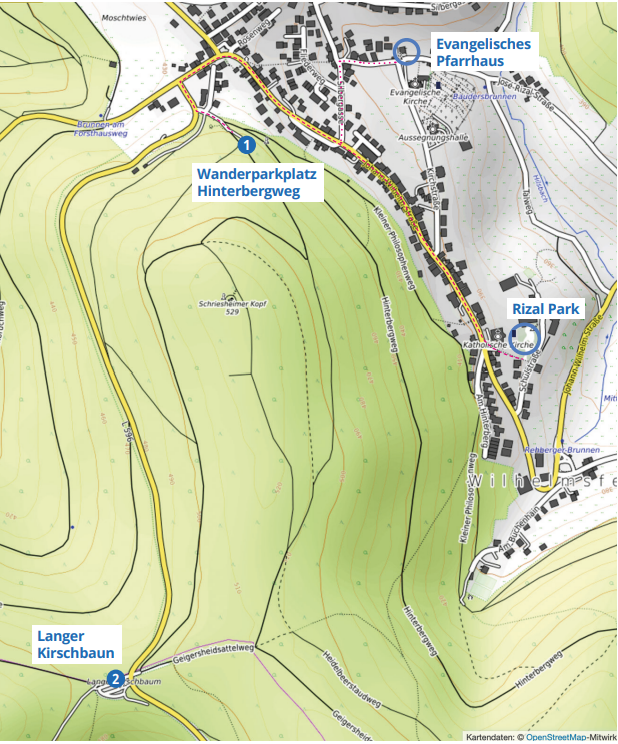
Starting point 3
PHILOSOPHENWEG in Heidelberg, opposite the location of the former Jubiläumseiche
This starting point can only be reached on foot. To do so, cross the Neckar river via the Karl Theodor Bridge (Old Bridge). Here you can choose between the two routes alternatively used by Dr. Rizal.
ALTERNATIVE A – via Schlangenweg – Philosophenweg
Directly at the end of the bridge, there is a pedestrian crossing on the left, which you should cross. Immediately on the right, you will find a sign for the Schlangenweg.
Follow this sign and continue up the steep ascent (partly with steps) to the end of the path. Here you will reach the Philosophenweg, where you turn right. After approximately 200 m, you will find the information board for the Rizal Historic Trail on the left-hand side.
ALTERNATIVE B – via Hirschgasse – Philosophenweg
After crossing the bridge, turn right onto the riverside road (Ziegelhäuser Landstraße) and walk along the Neckar as far as the next traffic lights. Cross the road there and turn into Hirschgasse.
Walk up the steep street, passing the Mensur Hall, where Dr. Rizal watched the students during their activities (see his letter of 26 February 1886 to his parents).
Approximately 150 m beyond the Mensur Hall, follow the branch in the road leading onto the path that ends at the Philosophenweg.
After a few metres, you will find the information board for the Rizal Historic Trail. From the respective starting point, follow the marked Rizal Historic Trail.
The total distance from Wilhelmsfeld to the Karl Theodor Bridge (Old Bridge) in Heidelberg is approximately 10.5 km. A further 1.5 km must be covered to reach the workplace at the University Eye Clinic.
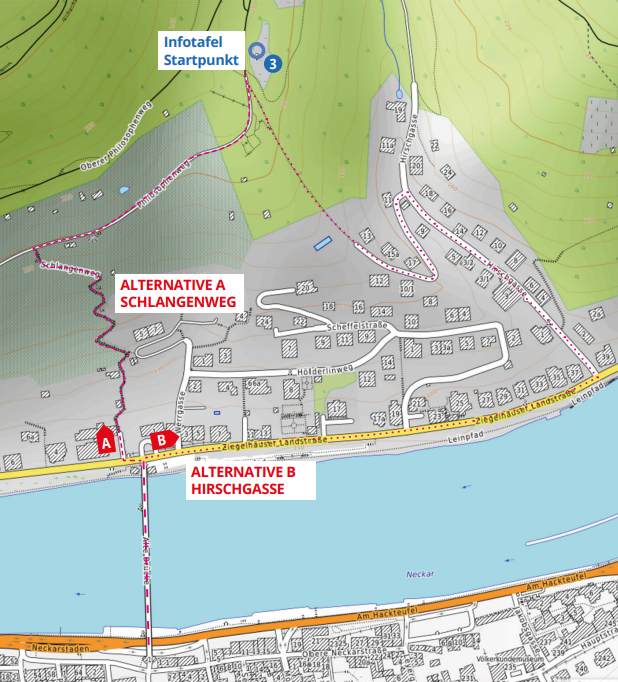
Getting there by public transport
The Rizal Historic Trail can be walked from either end.
STARTING POINT WILHELMSFELD
From Heidelberg Central Station, take Bus 34 towards Wilhelmsfeld, Autohalle and get off at the stop Wilhelmsfeld, Schriesheimer Hof. From there, the Hinterberg trailhead and the western entrance to the Rizal Historic Trail can be reached within a few minutes on foot.
STARTING POINT HEIDELBERG (Schlangenweg or Hirschgasse)
From Heidelberg Central Station, take any tram or bus connection to Bismarckplatz. From there, take Bus 34 towards Wilhelmsfeld, Autohalle or Bus 37 towards Ziegelhausen, Heidebuckelweg and get off at either Neuenheim, Alte Brücke Nord (starting point: Schlangenweg) or Hirschgasse (starting point: Hirschgasse). Both trail entrances are located just a short walk from the respective bus stops.
Alternatively, you can walk from Bismarckplatz or Heidelberg-Altstadt station to Hirschgasse (approx. 10 minutes) or to the Schlangenweg trailhead (less than 20 minutes). The Schlangenweg ascent can also be reached directly on foot from Bismarckplatz in approximately 25 minutes.
As the Rizal Historic Trail is a point-to-point route, visitors may find it convenient to start at one end and return by public transport from the other.
For current timetables and journey planning, please visit:
Verkehrsverbund Rhein-Neckar (VRN) – www.vrn.de
Trail Markings
The Rizal Historic Trail is marked in both directions. Trail markers can be found on trees along the route and, in some cases, on small signposts.
Please follow the markers shown below. Some may be supplemented with directional arrows indicating the correct route.
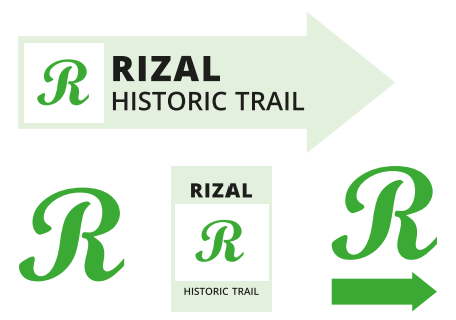
The trail passes through a protected nature reserve. Please be mindful of your surroundings and help preserve the natural environment. Further information can be found in our brochure (PDF download), page 12.
A Short Biography of Dr. José Rizal
WITH A FOCUS ON HIS STAY IN WILHELMSFELD AND HEIDELBERG
José Protasio Rizal Mercado y Alonso Realonda was born on 19 June 1861 in Calamba in the Philippines and is regarded as the national hero of his country. He was a physician, writer, patriot, artist, and an important freedom fighter in the struggle against Spanish colonial rule.
Rizal grew up as the seventh of eleven children and, from an early age, displayed exceptional intellectual abilities, a passion for learning, and a deep love for his homeland. At a young age, he developed an interest in literature, history, and science. He spoke several languages fluently, including Spanish, Tagalog, English, French, German, and Latin.
Rizal began his formal education in the Philippines, where he studied philosophy and literature among other subjects. Later, he continued his studies in Europe in order to study medicine, with a particular focus on ophthalmology.
On 3 February 1886, José Rizal arrived in Heidelberg to further his medical training. He practised ophthalmology at the Heidelberg University Eye Clinic under the renowned ophthalmologist Prof. Otto Becker.
From April to June 1886, he lived in nearby Wilhelmsfeld, a small village near Heidelberg, as a guest of the parish family of Karl Ullmer in the community parish house. There, on 19 June 1886, he celebrated his 25th birthday together with the Ullmer family. During his time in Wilhelmsfeld, he continued his studies and literary activities and completed his first novel, Noli me Tangere. He left Heidelberg on 9 August 1886 and travelled via several stops to Berlin, where he arrived on 1 November 1886 and published Noli me Tangere in Spanish in mid-March 1887.
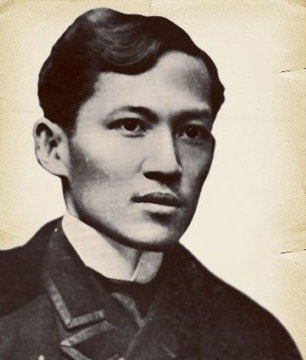
Rizal’s time in Germany was formative for his intellectual development and his commitment to Philippine independence. His novels Noli me Tangere and El Filibusterismo, as well as his other literary activities, contributed to shaping his vision of a free and educated Philippine people. He was also politically active, committed himself to reforms, and advocated the rights of his people.
However, his writings and commitment earned him enemies, especially among the Spanish monastic orders and colonial rulers. José Rizal returned to the Philippines in 1892, where he continued to fight for reforms. He founded the movement La Liga Filipina, which sought social and political reforms. His activities led to his arrest and ultimately to his execution on 30 December 1896 by the Spanish colonial authorities.
Dr. José Rizal was an extraordinary man whose life was shaped by education, patriotism, and the pursuit of justice.
His stay in Wilhelmsfeld and Heidelberg was a formative period during which he deepened his medical knowledge and further developed his patriotic ideas. This period contributed significantly to shaping him into the national hero he is today. His legacy lives on in the Philippines and throughout the world as a symbol of the struggle against oppression and for the freedom of his people.
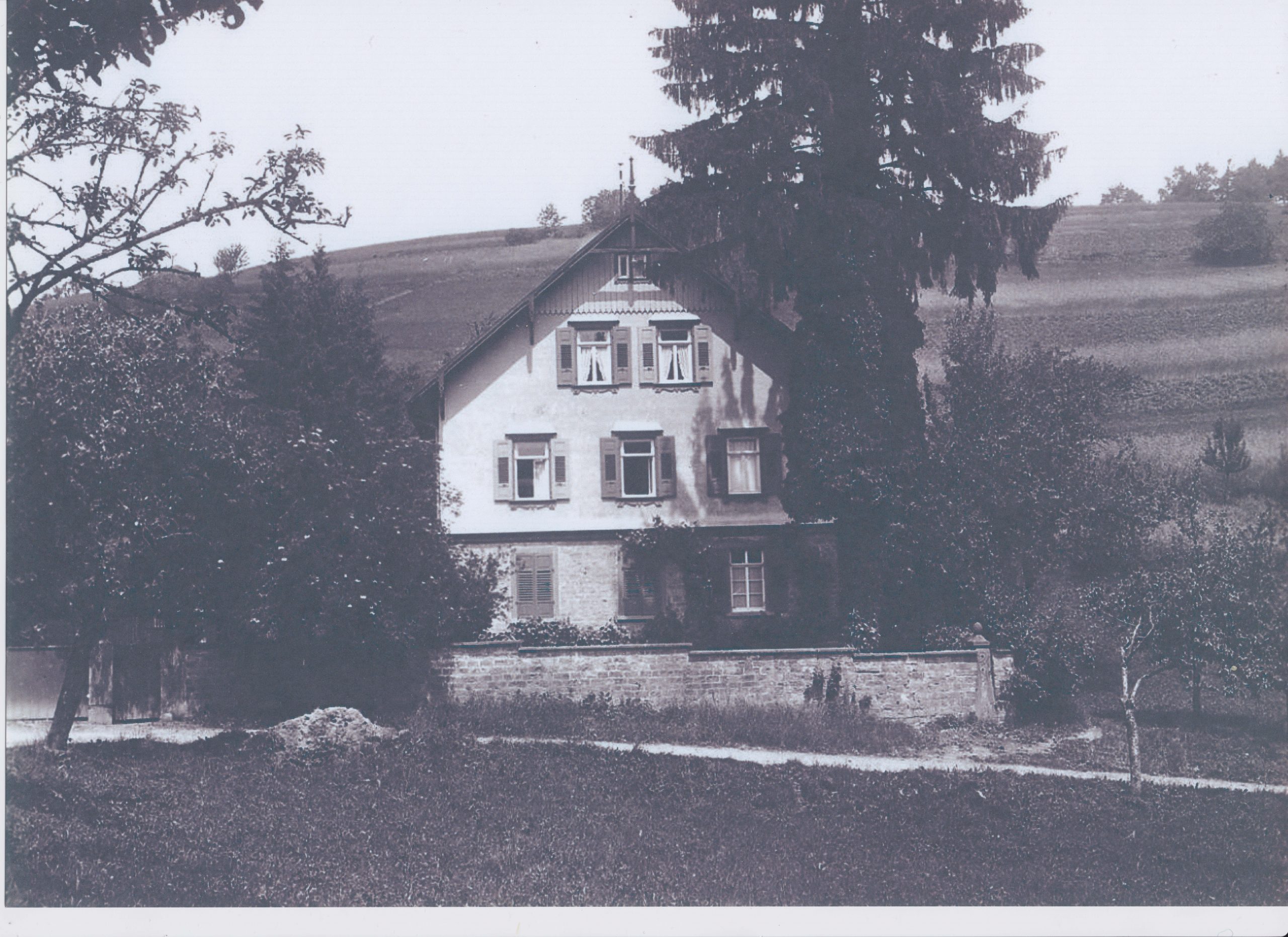
Evangelisches Pfarrhaus Wilhelmsfeld, ca. 1920
A “normal working day” in the life of Dr. José Rizal
Wilhelmsfeld, a farming village in the Odenwald, had neither running water nor electricity. The journey to Heidelberg could only be made on foot, as there was neither a railway connection nor buses. These were introduced only later.
In April 1886, Dr. José Rizal moved his residence from Heidelberg to Wilhelmsfeld because the financial support payments from his brother Paciano had not arrived on time and living in Wilhelmsfeld was less expensive. Rizal lived for more than three months as a member of the Ullmer family in the parish house in Wilhelmsfeld.
What Did Rizal’s Daily Routine Look Like at That Time?
Wilhelmsfeld, a farming village in the Odenwald, had neither running water nor electricity. The journey to Heidelberg could only be made on foot, as there was neither a railway connection nor buses. These were introduced only later.
The pastor rose at 5.00 a.m. and invited his guest to come to his study for German lessons. Besides becoming acquainted with German life and German customs, he wished to improve his knowledge of German. Schiller’s Wilhelm Tell was chosen as the textbook. In those years, Schiller was the European poet who had expressed most clearly the problems of dictatorship, oppression, and contempt for humanity.
When the sun rose at around 5.45 a.m., José accompanied the pastor’s 17-year-old daughter Margaretha, known as Eta, into the garden to water the plants. The chickens and geese had to be fed, as did the pig. Eta remarked: “It is only fair that the young guest should help me with my morning duties.” Eta was 17 years old at the time. In this sense, the Ullmers were self-sufficient. The income of a village pastor was modest. Seated at the family table were the pastor (44 years old), his wife Marie (43 years old), his son Fritz (15 years old, grandfather of Dr. Fritz Hack-Ullmer), and his daughter Eta (great-aunt of Dr. Fritz Hack-Ullmer).
Dr. José Rizal arrived as a stranger and a guest, but soon became a friend.
For breakfast there was milk, local tea (peppermint or camomile), green tea on Sundays, home-baked bread, and homemade jam. Marie packed the same breakfast for lunch and gave it to José when, at 6.45 a.m., he set off on foot along the direct forest paths to the Eye Clinic of Heidelberg University. He must have walked very quickly, since the route descended for approximately 9.5 km. Craftsmen from Wilhelmsfeld, who also used this route regularly, needed around 1.5 hours for the downhill journey towards Heidelberg and approximately 2 hours for the uphill return journey.
From 8.00 a.m. until 4.30 p.m., work at the clinic took place either in the outpatient department or in the operating theatre under the famous Professor Otto Becker. There were probably eight other doctors working there as well. The hospital had been built in 1878 as a specialised eye clinic solely for eye patients and their needs.
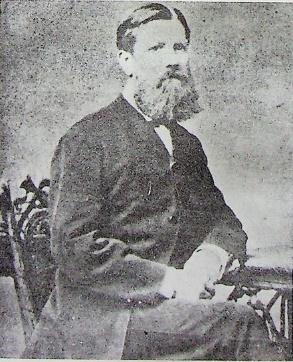
Pastor Karl Ullmer
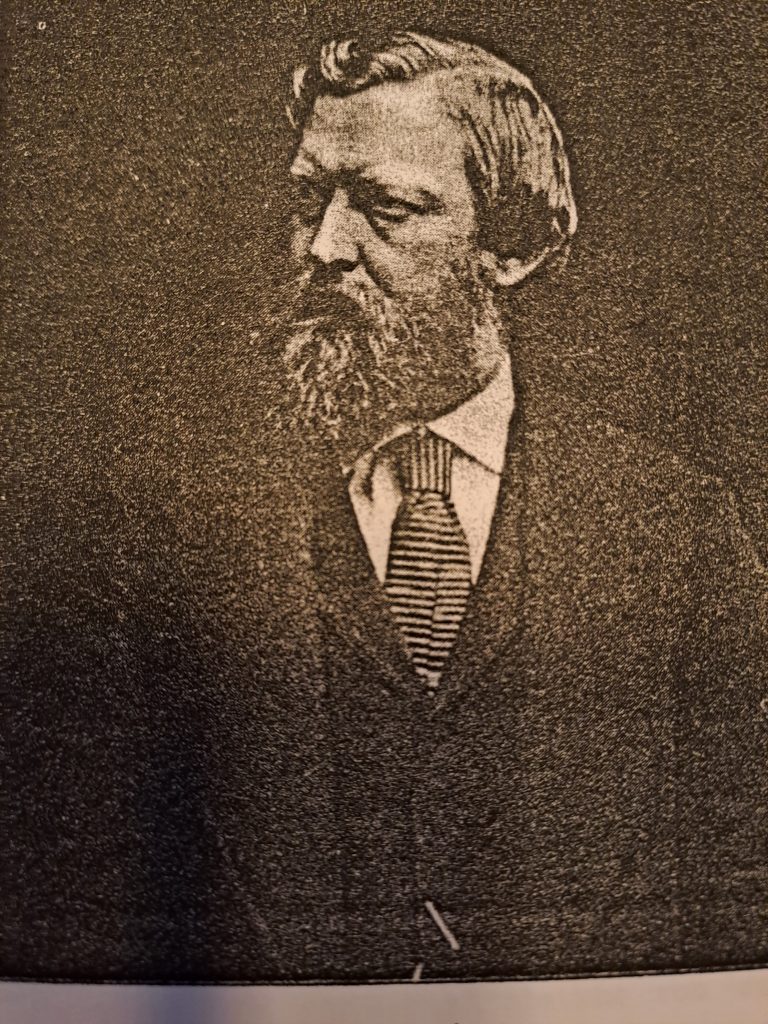
Professor Otto Becker
At around 5.00 p.m., he began the steep climb back to the parish house in Wilhelmsfeld. The daily hot meal was served upon arrival. First came the soup, then the main course: meat (chicken, pork, goat, occasionally game) was served only once a week; otherwise there were vegetables, turnips, salads, and potatoes.
From 9.00 p.m. onwards, the family spent the evening together without radio or television, with readings from books or world news from the Frankfurter Zeitung and discussions about it. Not to be forgotten were the open discussions and José’s descriptions of the Philippines and his latest passages from Noli me Tangere, written the previous evening.
The magazine Gartenlaube was also read, often featuring the illustrations and stories of Wilhelm Busch. Ullmer had met the illustrator and humourist in Munich, and Busch visited him once in Wilhelmsfeld in the mid-1880s. An oil painting of a mountain landscape by Busch hung in the sitting room of the parish house. Karl Ullmer played the violin. Many German folk songs were sung, and José sang songs in Tagalog in his fine baritone voice, which brought great joy to all who listened.
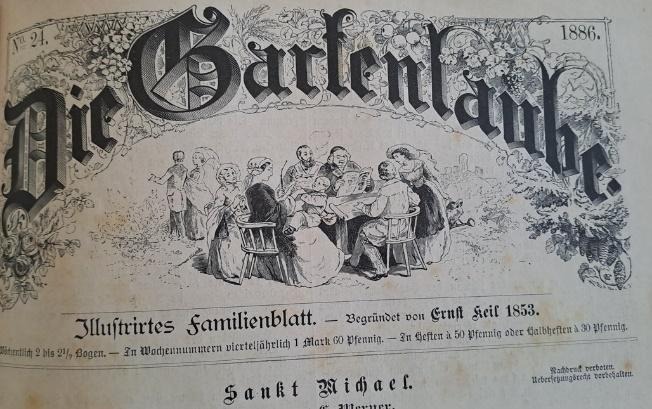
Eine Ausgabe von der „Gartenlaube“
At 10.00 p.m., the Ullmer family went to bed. At nightfall, wax candles or an oil lamp were lit.
Rizal needed only five hours of sleep. He regularly worked for two hours by candlelight in the guest room until midnight. He made substantial revisions to his great first novel Noli me Tangere, as can be seen from the many corrections, and also added a section unmistakably describing the Odenwald around Wilhelmsfeld (see Chapter 7 of the German edition of Noli me Tangere).
Quotes from Letters
Rizal, Heidelberg, 24th April 1886 to Pastor Ullmer
To the Reverend Pastor Ullmer in Wilhelmsfeld.
Reverend Pastor,
I promised to write to you should I decide to live in the countryside for several weeks, since you were kind enough to offer to help me find accommodation. On Sunday evening, weather permitting, I shall be in Wilhelmsfeld. I have been told that the inhabitants of Wilhelmsfeld do not speak proper German, but rather a dialect; if I were not afraid of abusing your kindness, I would ask you, if at all possible, to let me stay with you rather than elsewhere, for not only would I live with a venerable family whose friendship is dear to me, but I would also speak good German, which I consider the main thing. However, if this is impossible or inconvenient for you, I shall take whichever room you consider suitable, whatever it may be.
Please convey my greetings to your whole kind family. Accept in advance my thanks and the assurance of my deepest respect.
J. Rizal
Rizal, Heidelberg, 26th Juni 1886 to Pastor Ullmer
To Pastor Ullmer
( Your Honour)
… Yesterday, halfway along the road, I suddenly saw Bärle running behind me. Despite the stones I threw at him, and despite all my efforts, I could not send him back. For a long time he followed me from afar; finally, I decided to bring him with me, since Friedrich will be going home today. I gave him a fine supper (milk and bread), and the people here treated him kindly …
… May you too, whenever you are in a foreign land, receive the same kindness and friendship that I found with you: and if I, a stranger in a foreign country, am nothing, I may still be of worth in my homeland, where you will always find a good friend, provided of course that I do not die. The joy of being understood by other people is so great that one cannot easily forget it. You have also understood me despite my brown skin, which for some people appears mysterious or meaningless: fortunately, for some it gradually becomes lighter, for example for the innkeeper in Heilig +Steinach2 ; though unfortunately not everyone is an innkeeper.
I greet Frau Pfarrerin and Eta most warmly and wish you the happiest future.
Your good friend,
Rizal
Rizal to Friedrich Ullmer, Munich, 29th May 1887
… Please greet the good Pastor’s wife, your dear mother, and tell her that I shall write to her when I return home. I shall never forget how kind she and your father were to me when I was an unknown stranger without friends or recommendations staying with you … I shall never forget Wilhelmsfeld and its hospitable parish house …
Rizal, Heidelberg, 26th(?) February 1886, a letter to his parents and brothers
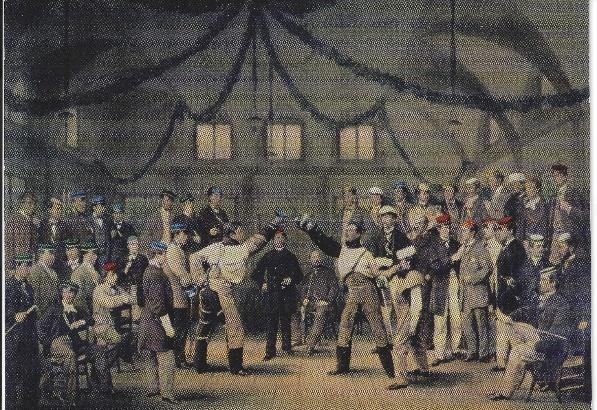
Mensur auf der Hirschgasse, um 1865
. Three times I went to their duels in the Hirschgasse and witnessed 20 to 25 of them; each time 7, 8, or 9 men fought, and on several occasions the fights ended bloodily. Once I saw a duellist struck six times during a duel. Sometimes they are not injured. They fight only among themselves, fraternity against fraternity, often without any reason at all, for those who choose the opponents are the seconds. The duels serve only to test bravery and to demonstrate personal honour and courage. There are five student fraternities here, namely Vandalia, Guestfalia, Saxoborussia, Rhenania, and Suebia …
Quotes from Noli me Tangere
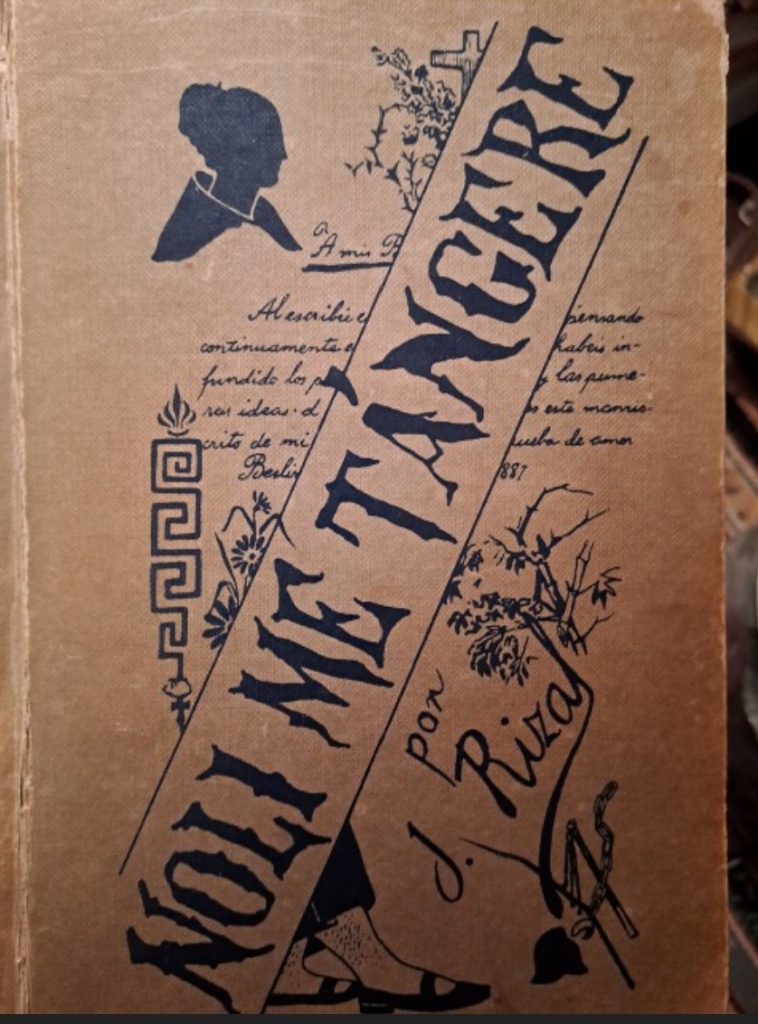
Originalband Noli me Tangere
In Chapter 7 of the novel, Rizal’s alter ego Ibarra responds to Maria Clara’s question of whether he had thought of her during his travels, among other things, with the following words:
“Forget you? Often I believed I could hear your piano playing and the sound of your voice, and when, in Germany at dusk, I wandered through the forests inhabited by the wondrous figures of poets and the dark legends of old, it seemed to me as though I saw you in the veils of mist rising from the valley, as though I heard your voice in the rustling of the leaves, and when from afar the songs of the country people returning from their day’s work could be heard, it was as though their singing joined with the voices within me, as though they sang for you and gave reality to the floating image of my dreams.”
“At times I lost my way along the mountain paths, and the night, descending gently there, would still find me in the forest searching for my path among firs, beeches, and oaks, and when a moonbeam fell through a gap in the dense branches, you appeared to me in the depths of the forest like an elusive, loving shadow moving between the light and darkness of the thicket; and when the nightingale sang, I believed it had caught sight of you and that you had drawn those notes from it.“
Sponsors
We would like to express our gratitude and appreciation to our sponsors and donors and acknowledge their commitment to the welfare of society and international understanding.
Through their financial support, they have helped create a connected historical space linking the memorial sites dedicated to the Philippine national hero Dr. José Rizal in the Wilhelmsfeld and Heidelberg region.
Official Partner


Gold Sponsors

Prof. Dr. med. Manfred Fischer
Silver Sponsors


Sir Herbert Ehses, KCR & Lady Windy • Dr. Fritz Hack-Ullmer • Familie Damm-Ludwig • Sir Werner Filsinger, KGOR & Lady Rosalie • Sir Lucien Spittael, KGOR • Lady Ute Holtzmann
Bronze Sponsors